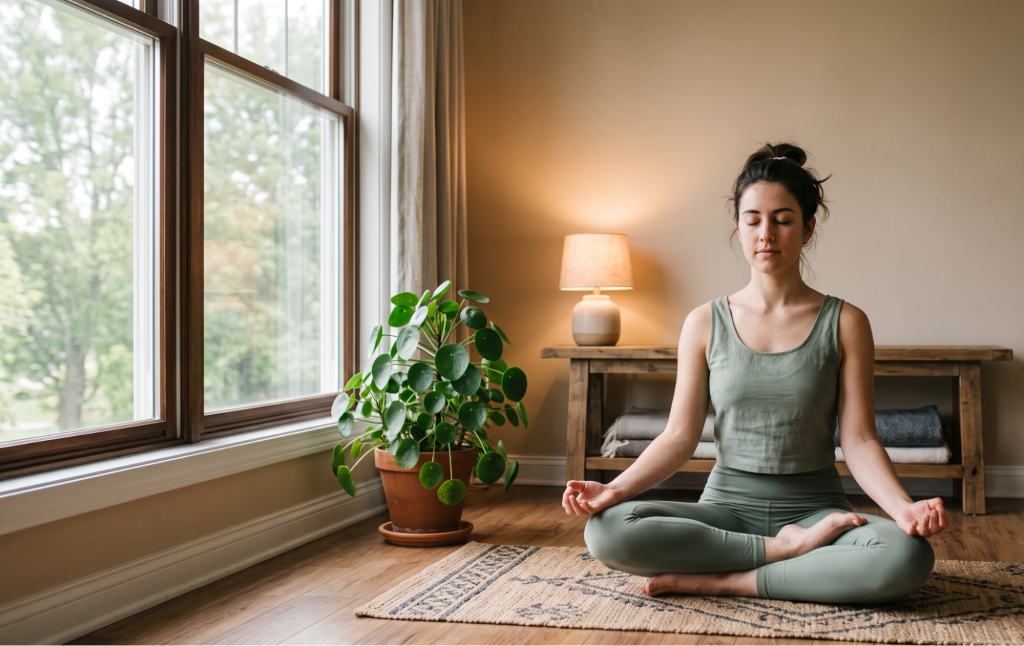

It is late evening and you finally have a moment to yourself. Except there is nowhere to actually have it. The sofa faces a television that is always on, the bedroom doubles as a laundry station, and your phone follows you from room to room. When every corner of your home is busy doing something else, your mind never gets the signal that it is safe to switch off.
A personal sanctuary changes that. It does not need to be a whole room, a big budget or a design project. It simply needs to be a space that belongs to you and asks nothing of you.
Why Your Surroundings Shape How You Feel
Your environment speaks to your nervous system all day long. Cluttered, noisy, brightly lit spaces keep your brain in a low level state of alert, while calm and orderly ones allow your stress response to settle. Natural elements play a part too. Research gathered by Mind shows that spending time around nature and greenery can improve mood, reduce stress and help you feel more relaxed. A sanctuary works because it concentrates these calming signals into one reliable spot.
Start With One Small Corner
Choose the quietest corner you have, even if it is just the space beside a window. Clear it completely, then add only three things: somewhere comfortable to sit, something soft such as a cushion or throw, and one item that means something to you. That might be a favourite book, a plant or a photograph.
Keep it deliberately sparse. Emptiness is the point, because it gives your eyes and mind nothing to process. If your home is genuinely too busy, the same idea works outdoors. A sheltered garden nook, a repurposed shed corner or a made to order summer house from specialists like Elfords can give you the same dedicated retreat with the added mood lift of being closer to nature. Wherever you set up, our home reset wellness guide is a good place to begin if the rest of the house needs calming down first.
Calm the Senses With Light, Scent and Sound
Once the space exists, shape how it feels. Swap harsh overhead lighting for a warm lamp or candles, since soft light tells your body the day is winding down. Add a gentle scent if it suits you. Johns Hopkins Medicine notes that lavender in particular may help ease anxiety and support better sleep. For sound, try quiet instrumental music or nature audio, or simply enjoy the novelty of silence.
You do not need all three at once. Pick whichever sense responds most strongly for you and start there.
Protect the Space With Boundaries and Rituals
A sanctuary only works if it stays sacred. Keep phones, laptops and work materials out of it entirely, so the space never becomes another place your inbox can find you. Ask the people you live with to treat it as your quiet spot too.
Then build a small ritual around it. Ten minutes of journaling in the morning, a chapter of a book before bed, or a short breathing practice all work well. One simple option is 4-7-8 breathing, where you inhale for four seconds, hold for seven and exhale for eight, and the NHS breathing exercises for stress offer a gentler alternative if that feels too long. Repetition is what teaches your brain that this spot means rest, so the calm arrives faster each time you sit down.
A Space That Tells Your Brain to Rest
Your sanctuary does not need to be perfect, large or expensive. It needs to be yours, protected and used often. A cleared corner, a warm lamp, a closed door or a quiet garden room can all do the same job, which is giving your mind one dependable place to exhale. For more practical ideas on feeling better at home, explore our blogs.
Try It Now: One Minute of 4-7-8 Breathing
Breathe in through your nose for 4 seconds, hold for 7, then exhale slowly through your mouth for 8. Follow the circle and let it set the pace.
Three rounds takes about one minute